Kroger Under Fire: Nonprofit Accuses Grocery Giant of Profiling Shoppers and Profiting From Customer Data
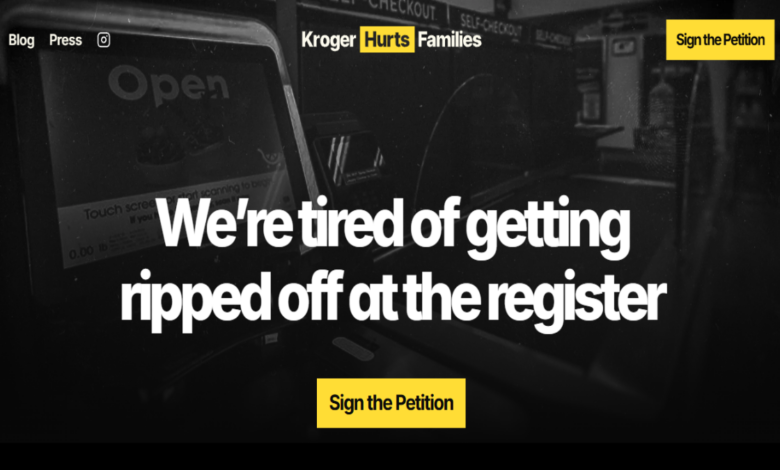
National advertising campaign raises questions about customer surveillance, grocery pricing, personal information and whether shoppers are paying more than they should.
By Miles J. Edwards | A.T.L. N.E.W.S.
Sunday, November 22, 2026
ATLANTA, Ga. — The next time you walk into a Kroger supermarket, grab a shopping cart and begin filling it with groceries, you may want to consider something beyond the prices displayed on the shelves. How much does the grocery retailer know about you, your family, your finances and your shopping habits? More importantly, what happens to that information after you leave the store?
Those questions are at the center of a national advertising campaign accusing one of America’s largest supermarket operators of collecting extensive personal information about its customers, creating detailed consumer profiles and profiting from the data. The campaign, called Kroger Hurts Families, is being organized by the Center for Responsible Food Business, a Pennsylvania-based nonprofit advocating for greater transparency and accountability in the grocery industry.
The organization has taken its accusations directly to consumers through television commercials, billboards, social media and online advertising. The commercials have aired during NFL broadcasts, while billboards have appeared in several metropolitan areas, including Atlanta, Cincinnati, Columbus and Nashville. The campaign has also expanded into Houston, where organizers are targeting concerns about grocery affordability and consumer privacy.
Who Is Behind the Commercials?
The Center for Responsible Food Business was founded in 2023 by Taylor Warren, who serves as the organization’s president. According to reporting by the Houston Chronicle, the nonprofit launched the Kroger Hurts Families campaign in June 2026 after reviewing government records, compiling research and receiving complaints from customers about their experiences at Kroger stores.
Warren told the newspaper that the organization had received approximately 2,000 consumer testimonials from Georgia, Tennessee, Ohio and Texas, with more than a third of respondents reporting that they had been overcharged at checkout. Those figures reflect complaints submitted to the advocacy group, rather than a representative survey of all Kroger customers, but they have become a central part of the nonprofit’s campaign.
The nonprofit argues that grocery affordability involves more than the price of food. It is also concerned with how supermarkets collect information about consumers, whether digital technology allows retailers to influence purchasing decisions and whether shoppers have meaningful control over their personal information.
Is Kroger Creating Secret Profiles of Its Customers?
While the nonprofit’s advertisements have attracted attention, allegations about Kroger’s customer data collection did not originate with the campaign. In May 2025, the independent consumer advocacy organization Consumer Reports published an investigation examining how Kroger collects, analyzes and monetizes information through its loyalty program and marketing operations.
The investigation found that Kroger uses shopping histories and other consumer information to create detailed profiles of customers. Those profiles can include predicted household income and other inferences about a shopper’s personal circumstances. Kroger’s internal data analytics business, known as 84.51°, processes consumer information to support marketing, advertising and personalized promotions for Kroger and other businesses.
One particularly concerning finding involved an Oregon consumer who obtained information about his personal shopping profile through a request under state privacy law. Consumer Reports determined that information associated with his profile may have been made available to more than 50 companies, including data brokers, financial businesses and marketing firms. The investigation did not establish that all those companies received or used his information, but it raised substantial questions about how widely consumer data can circulate beyond the grocery store.
Unlike a traditional loyalty card that simply rewards customers for repeat purchases, modern retail data systems can combine purchase information with demographic estimates, online behavior and predictive analytics. This allows companies to make assumptions about a household’s financial resources, purchasing preferences and potential interest in particular products, sometimes without shoppers fully understanding the extent of the profiling.
Kroger’s own privacy policy confirms that the company collects and processes several categories of consumer information and may disclose information for targeted advertising or in ways legally classified as a sale of personal data. The categories include purchasing information, electronic activity, approximate location and inferences about consumers.
Could Kroger Use Your Personal Information to Determine What You Pay?
One of the campaign’s more serious accusations involves a practice known as surveillance pricing, in which businesses use personal information, algorithms or other analytical tools to determine the prices or offers presented to individual customers. Critics worry that retailers possessing extensive consumer data could eventually determine how much particular shoppers might be willing to pay for essential products, potentially undermining the idea that customers should receive equal prices for the same merchandise.
Kroger has introduced electronic shelf labels that allow prices to be updated digitally, raising concerns among privacy advocates about how the technology might eventually be combined with customer information. However, there is an important distinction between the technology’s capabilities and evidence of its actual use. Kroger has denied using personalized pricing, maintaining that its systems provide personalized savings through coupons and promotions rather than charging individual shoppers different shelf prices.
In a November 17 report by WOSU Public Media, Warren acknowledged that he did not possess evidence demonstrating Kroger was currently using its electronic shelf labels for dynamic pricing. The nonprofit nevertheless argues that the combination of extensive customer data and rapidly adjustable electronic prices creates a potential risk that deserves public scrutiny.
Facial Recognition and What Kroger’s Privacy Policy Reveals
Another issue receiving attention is Kroger’s use of in-store cameras and biometric information. The company’s privacy policy, updated in September 2026, acknowledges that certain locations may collect facial-recognition information for security-related purposes, including investigating theft, fraud and other criminal activity. Kroger states that notices are provided at locations where such information is collected.
The policy also describes the collection of transaction histories, loyalty-account identifiers, demographic information, device activity, location information and data obtained from other companies. It says the retailer may use shopping histories and other information to generate consumer inferences for advertising, promotional offers and personalized shopping experiences.
These disclosures do not establish that facial recognition is being used to change grocery prices or that every Kroger location collects biometric information. They do, however, demonstrate how information generated during an ordinary shopping trip can extend well beyond what customers place in their carts.
Customers Also Accuse Kroger of Overcharging
Customer privacy is only one part of the campaign. The nonprofit also accuses Kroger of repeatedly charging shoppers more at checkout than the prices advertised on store shelves, making certain discounts difficult to obtain and charging higher prices in communities with limited grocery competition.
In a September 2026 investigation titled Kroger’s Pricing Problem, the organization examined 389 government price inspections conducted at 101 Kroger stores across nine Ohio jurisdictions between 2022 and mid-2026. According to its analysis, inspectors identified overcharging at 36 stores, documented 644 incorrect prices and found that overcharges averaged more than 20 percent above advertised shelf prices. The report also found that pricing mistakes favored Kroger nearly three times as often as they favored shoppers.
Those findings are based on the inspections examined and do not establish the frequency of overcharging throughout Kroger’s nationwide network. Nevertheless, they provide a documented basis for some of the nonprofit’s allegations about checkout discrepancies, independent of the questions surrounding customer surveillance.
What Kroger Says About the Accusations
Kroger has publicly rejected allegations that it uses individualized surveillance pricing. In statements previously provided to news organizations, the retailer said that its electronic shelf labels do not identify individual shoppers or their purchasing histories and that the company does not use personalized pricing. It has characterized individualized discounts as a way of helping customers save money.
The company’s September 2026 privacy policy also explains that some of its data activities support aggregate analysis, targeted advertising, loyalty rewards and marketing services offered through its subsidiary 84.51°. Kroger presents these activities as part of its retail and advertising operations, although consumer advocates continue to question whether customers adequately understand how their information is collected and shared.
During November reporting on the advertising campaign, WOSU and other news organizations reported unsuccessful attempts to obtain additional responses from Kroger. A new, comprehensive response from the company addressing every accusation in the nonprofit’s current campaign has not been independently verified for this article.
What Can Kroger Shoppers Do About Their Information?
Consumers concerned about Kroger’s data collection can begin by reviewing the company’s privacy policy and examining the information associated with their loyalty accounts. Kroger provides privacy controls through which eligible customers can exercise certain rights, including requesting access to personal information, seeking deletion and opting out of qualifying data sales or targeted advertising.
Those rights vary by state, with certain states granting residents more extensive protections than others. Kroger also provides a telephone option for privacy requests at 1-800-KROGERS. Customers should understand that opting out of targeted advertising does not necessarily prevent all collection of transaction information needed to operate a retailer’s loyalty or payment systems.
Consumers who believe they have been overcharged can preserve receipts, photograph shelf prices and request corrections from the retailer. The Center for Responsible Food Business is also inviting shoppers to submit their experiences through its campaign website, Kroger Hurts Families, where the organization is circulating a petition calling for greater pricing transparency, restrictions on surveillance pricing and additional consumer privacy protections.
The Larger Question: Who Owns Your Shopping Habits?
For decades, grocery shopping appeared to be a straightforward transaction between a customer and a retailer. Shoppers selected products, paid the advertised prices and returned home with their purchases. Although stores have long studied buying patterns, loyalty programs and sophisticated data analytics have made it possible to associate ordinary purchases with increasingly detailed accounts of individual households.
The Kroger controversy reflects a broader question facing American consumers as retailers expand their digital advertising and analytics businesses: How much information should a supermarket be permitted to collect about the families it serves, and how much control should those families have over the resulting profiles?
For the Center for Responsible Food Business, the answer involves increased transparency, stronger consumer protections and restrictions on the use of personal information in grocery pricing. For Kroger, data-driven retailing remains part of its approach to customer rewards, personalized offers and advertising. Whether those business practices adequately protect customers is likely to remain a subject of public scrutiny as the campaign continues.
What is already established is that Kroger collects extensive consumer information and uses it to support sophisticated marketing operations. What remains unproven is the campaign’s suggestion that the company currently uses individualized surveillance pricing to charge particular shoppers the maximum amount they might be willing to pay.
As consumers face persistent pressure from grocery bills, the debate is no longer limited to how much they spend at the register. It increasingly concerns how much information they surrender in the process.
Editor’s Note: This article examines allegations raised by the Center for Responsible Food Business alongside publicly documented consumer-data practices. Kroger has denied engaging in individualized surveillance pricing. The accusations concerning such pricing have not been independently established as fact. No direct interview with Kroger or campaign representatives was conducted for this report.