Little Debbie Has Become Big Debra!
America’s once-affordable snack cake sweetheart is growing up, and judging by today’s grocery store prices, she’s developed some expensive tastes.
By Miles J. Edwards | A.T.L. N.E.W.S. | November 21, 2026
ATLANTA, GA — There was a time when a dollar could buy you a Little Debbie snack cake, something to drink, and perhaps even leave you with a little change in your pocket. For generations of Americans, Little Debbie was the queen of inexpensive sweet treats, offering everything from Honey Buns and Zebra Cakes to Nutty Buddy wafers and Swiss Rolls without requiring consumers to dig too deeply into their wallets.
But somewhere between yesterday’s childhood memories and today’s grocery store receipts, Little Debbie apparently grew up, got herself a promotion, and changed her name to Big Debra! And judging by the prices recently spotted at a Kroger supermarket, Big Debra isn’t playing around when it comes to collecting her money.
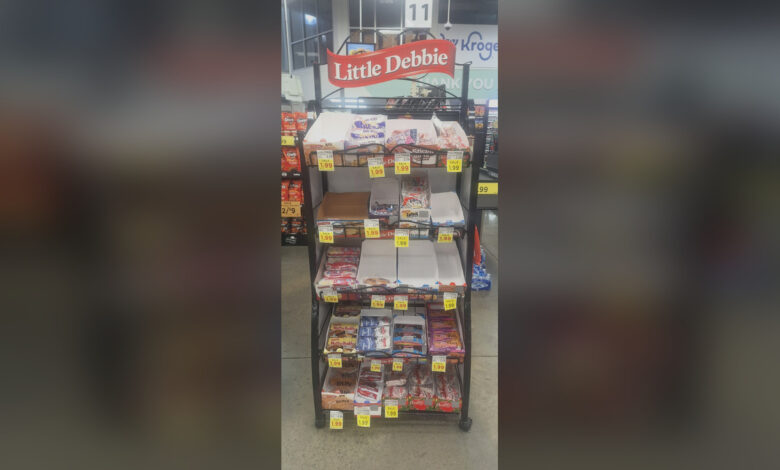
A recent photograph of a Little Debbie display inside a Kroger supermarket reveals individually wrapped snack cakes advertised at a regular price of $2.29 each, temporarily discounted to $1.99. That’s nearly two dollars for a single snack, not a multipack, not a family-sized box, and certainly not enough to stock the pantry for the week. Just one individually wrapped sweet treat that might disappear in three or four bites.
For longtime Little Debbie customers who remember when these snacks were synonymous with affordability, the prices are enough to make someone stop in the grocery aisle and ask a simple question: When did Little Debbie become so expensive?
When Little Debbie Was Actually Little
Little Debbie has been part of American snack culture for more than six decades. Introduced in 1960 by McKee Foods, the brand became a household name by offering affordable, individually packaged snack cakes that families could enjoy without spending a fortune. The familiar image of a smiling young girl wearing a straw hat became a symbol of childhood treats, lunchbox surprises, and inexpensive indulgences.
For many Americans, Little Debbie products were among the first things they learned to purchase with their own money. A few coins from a parent’s pocket, leftover lunch money, or change collected around the house could often buy something sweet at the neighborhood convenience store. The products were especially appealing because they offered a satisfying alternative to more expensive bakery desserts and name-brand candy.
Whether purchased from a corner store, gas station, supermarket, or vending machine, Little Debbie represented something increasingly difficult to find in today’s economy: a small pleasure that didn’t require much financial consideration. Customers could grab a snack without feeling as though they were making a significant purchase, and parents could occasionally treat several children without worrying about the impact on the household grocery budget.
That affordability became an important part of the brand’s identity. Little Debbie wasn’t supposed to be a luxury. She was the friendly neighborhood snack cake sweetheart who understood that everyone deserved something sweet, regardless of how much money they had to spend.
Apparently, Big Debra has a different understanding of that relationship.
Two Dollars for One Snack Cake?
The Kroger display tells a story that extends beyond the price of a single Honey Bun or Zebra Cake. With regular prices of $2.29 and sale prices of $1.99 displayed across much of the rack, what once seemed like a minor impulse purchase can now become a surprisingly expensive habit.
Consider a parent purchasing five individually wrapped snacks for children throughout the school week. At the regular displayed price, those five treats would cost $11.45 before any applicable taxes. Purchasing ten would bring the total to $22.90, and buying twenty over the course of a month would cost $45.80.
Even the advertised sale price doesn’t offer much relief. At $1.99 each, twenty individually wrapped snacks would still cost $39.80, representing a savings of just six dollars compared with the regular shelf price.
| Individually wrapped snacks | Regular $2.29 | Sale $1.99 |
|---|---|---|
| 1 snack | $2.29 | $1.99 |
| 5 snacks | $11.45 | $9.95 |
| 10 snacks | $22.90 | $19.90 |
| 20 snacks | $45.80 | $39.80 |
Of course, these calculations reflect the prices photographed at one Kroger location and should not be interpreted as Little Debbie’s nationwide pricing. Individual retailers determine their own shelf prices, which can vary depending on location, product, package size, and promotional agreements.
Nevertheless, the display illustrates a growing frustration among American consumers who are finding that even the smallest purchases require more consideration than they once did. When a single packaged snack approaches the price of some inexpensive breakfast items or grocery staples, shoppers may begin questioning whether convenience and nostalgia are worth the additional expense.
Inflation, Corporate Costs, and the Disappearing Dollar
Little Debbie is hardly alone in becoming more expensive. Across the food industry, manufacturers and retailers have faced increased expenses associated with ingredients, packaging, labor, transportation, and distribution. Those costs, combined with broader inflationary pressures, have contributed to higher prices throughout grocery stores and convenience markets.
Snack cakes are particularly exposed to several of these expenses because their production requires ingredients such as flour, sugar, vegetable oils, cocoa, and dairy-related products, along with individual wrappers, cartons, and transportation to retail locations. Changes in the costs of these materials can influence what manufacturers charge distributors and retailers, although the precise effect on Little Debbie’s current prices would require additional information from McKee Foods.
There is also the question of how much of the final shelf price is determined by the manufacturer and how much is established by the retailer. A $2.29 price tag at Kroger does not necessarily mean McKee Foods receives that amount for each snack, nor does it establish that the manufacturer alone is responsible for the increase.
Still, consumers generally don’t see the financial arrangements between manufacturers, distributors, and grocery chains. They see the price printed on the shelf, compare it with what they remember paying, and decide whether the product is worth purchasing.
For shoppers already struggling with rising housing costs, utilities, insurance premiums, and other household expenses, even a relatively small increase in snack prices can become another reminder that their purchasing power isn’t what it used to be.
Are We Getting Less for More?
Beyond higher prices, consumers have increasingly questioned whether packaged food products are delivering the same value they once did. The practice commonly known as shrinkflation, in which manufacturers reduce package sizes or quantities without making proportional price reductions, has become a frequent subject of discussion among shoppers.
However, there is an important distinction between rising prices and shrinking products. The photograph of the Kroger display establishes the advertised prices of the individually wrapped snacks, but it does not establish that Little Debbie has reduced the size or weight of those products.
Determining whether customers are receiving less product for their money would require comparing historical and current package weights, serving sizes, and retail prices for the same items. It would also require distinguishing individually wrapped products from the multipack boxes traditionally sold in supermarkets, since those different formats can have substantially different per-snack prices.
That distinction matters because a $2.29 individually wrapped Honey Bun cannot automatically be compared with the per-unit cost of a snack purchased in a multipack. Packaging formats, distribution channels, and retailer pricing can all affect the final amount consumers pay.
But even without evidence of shrinking products, the question of affordability remains. If consumers once considered Little Debbie a dependable budget-friendly treat, today’s prices may be challenging that perception.
Has America’s Favorite Budget Snack Become a Luxury?
There is something almost comical about watching a brand built around a little girl’s image become the subject of grown-up financial calculations. Little Debbie has never positioned herself as an upscale dessert company competing with gourmet bakeries, specialty pastry shops, or expensive coffeehouse treats. Her appeal has traditionally been rooted in familiarity, convenience, and affordability.
That is precisely why the prices displayed at Kroger are so noticeable. Consumers generally expect specialty desserts to command higher prices, but a mass-produced, individually wrapped snack cake carries a different set of expectations. It is supposed to be the inexpensive option, the quick purchase made while stopping for gasoline, or the little something extra added to a grocery basket.
The irony is that consumers may now find themselves evaluating Little Debbie products in much the same way they evaluate other discretionary purchases. Is that Honey Bun really worth $2.29? Would it make more sense to purchase a multipack? Should they wait for a better sale, choose a competing brand, or skip the snack altogether?
These are reasonable questions, particularly for families managing tight budgets. A single snack cake may not determine anyone’s financial future, but repeated purchases across numerous grocery categories can have a meaningful cumulative impact.
And while Little Debbie products remain widely recognizable, brand loyalty does not guarantee that consumers will continue purchasing them at every price point.
Big Debra, We Need to Talk!
Perhaps the most disappointing part of the Kroger display isn’t that Little Debbie snacks are selling for $2.29. It’s that the promotional price of $1.99 is being presented as a bargain.
For consumers who grew up associating the brand with pocket change and inexpensive indulgences, paying nearly two dollars for one individually wrapped snack hardly feels like a celebration of savings. It feels more like another example of how much the American grocery experience has changed.
To be fair, one store display cannot tell us everything about Little Debbie’s national pricing strategy, historical price increases, or the financial pressures facing McKee Foods. A broader examination of retail prices over the past decade would be necessary to determine how much these products have increased in cost and whether those increases have outpaced general food inflation.
But what the photograph does reveal is enough to inspire a little consumer frustration, a little nostalgia, and perhaps a little humor.
Little Debbie has been part of American childhoods for generations, and there’s no reason to believe consumers have suddenly stopped enjoying her snack cakes. The question is whether the affordability that helped make the brand so popular can continue to survive in an economy where even the smallest treats are becoming increasingly expensive.
Because at $2.29 for an individually wrapped snack cake, Little Debbie is starting to look less like the neighborhood sweetheart who used to take our spare change and more like a grown woman with a mortgage, car payment, and expensive taste.
Little Debbie, we still love you. But sweetheart, you’ve become Big Debra, and apparently, Big Debra has bills to pay!