Black November: How Black Friday Became a Monthlong Shopping Frenzy
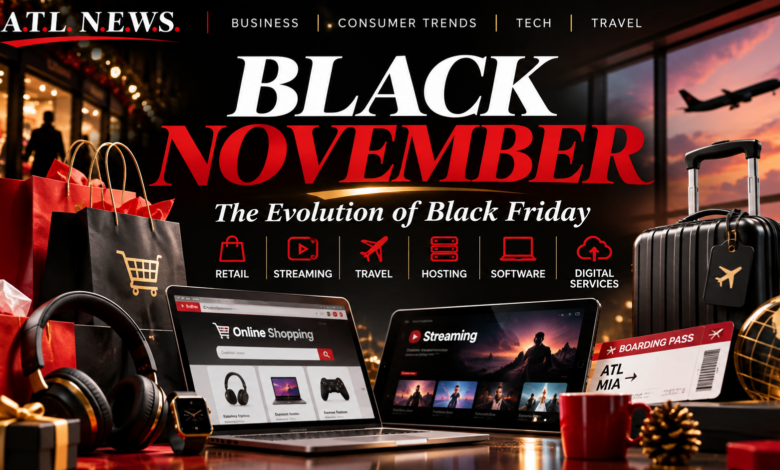
From Philadelphia’s congested streets to discounts on streaming, vacations, technology, and digital services, Black Friday has evolved into an entire shopping season. Here’s the history behind the tradition and a look at the deals being promoted in 2026.
By Miles J. Edwards | A.T.L. N.E.W.S.
Published: November 21, 2026 | Last Updated: November 21, 2026
There was a time when Black Friday meant waking up before sunrise, grabbing the newspaper advertisements, and preparing for a long day of navigating crowded shopping malls and department stores. Shoppers waited in lines outside retailers, sometimes in freezing temperatures, hoping to secure deeply discounted televisions, toys, appliances, and other holiday gifts before supplies disappeared. For many American families, the Friday after Thanksgiving became as much a holiday tradition as Thanksgiving dinner itself, complete with shopping strategies, carefully planned routes, and friendly competition over who could find the biggest bargain.
Over the years, however, the shopping event that once occupied a single Friday has evolved into a monthlong competition for consumer spending. Retailers have gradually abandoned the idea of limiting their biggest holiday promotions to the day after Thanksgiving, instead introducing early sales, exclusive membership offers, and extended promotional events that begin weeks before the holiday. What was once a one-day rush to department stores has expanded into a national shopping season that increasingly takes place on smartphones, computers, and other digital devices.
The transformation extends far beyond traditional retail merchandise. In 2026, consumers are being offered promotional pricing on everything from television and movie streaming subscriptions to vacation packages, website hosting, computer software, online security services, and other products that would have seemed unrelated to Black Friday just a generation ago. With major retailers already advertising holiday discounts before Thanksgiving week, America’s biggest shopping day has effectively become something much larger: Black November.
EDITOR’S NOTE: BLACK NOVEMBER 2026 SAVINGS UPDATES
A.T.L. N.E.W.S. will continue updating this article throughout the holiday shopping season as additional sales, discounts, and special promotions are announced and verified. Our coverage will extend beyond traditional retail merchandise to include streaming subscriptions, travel packages, website hosting, software, digital services, and other opportunities that may help consumers reduce their expenses. Readers are encouraged to bookmark this article and return frequently for newly announced offers, updated pricing, and additional savings opportunities.
Last updated: November 21, 2026. Promotional prices and availability are subject to change.
The History of Black Friday: How Did It All Begin?
Despite its modern association with shopping bargains and holiday spending, the expression “Black Friday” has a history that predates the retail phenomenon by nearly a century. One of its earliest widely documented uses occurred on September 24, 1869, when an attempt to manipulate the American gold market resulted in a financial crisis that disrupted markets and damaged fortunes. Although that event had no connection to Thanksgiving shopping, it demonstrated how the expression was historically associated with financial trouble, public disorder, or other unwelcome developments.
The Black Friday associated with the day after Thanksgiving emerged much later, particularly in Philadelphia during the 1950s and 1960s. Police officers used the term to describe the congestion and disorder created when large numbers of holiday shoppers, visitors, and football fans descended on downtown Philadelphia around the annual Army-Navy football game. Streets became overwhelmed with automobiles, sidewalks filled with pedestrians, and officers faced unusually demanding assignments as they attempted to maintain traffic flow and public order throughout the city.
For the police officers required to work extended shifts, the Friday after Thanksgiving was hardly a day worth celebrating. Philadelphia merchants reportedly attempted to replace the negative description with the more appealing expression “Big Friday,” hoping to associate the shopping activity with commercial opportunity rather than inconvenience. The alternative failed to gain lasting popularity, however, and the original name gradually spread beyond Philadelphia as the shopping tradition gained national recognition.
Over time, retailers embraced the expression and helped transform its meaning from a description of urban chaos into a symbol of holiday shopping excitement. One particularly popular explanation suggested that Black Friday represented the day retailers moved from operating at a financial loss, traditionally recorded in red ink, to earning profits, recorded in black ink. Although the accounting explanation became a widely repeated part of retail folklore, historians generally identify it as a later interpretation rather than the origin of the Thanksgiving shopping term.
How Black Friday Became an American Shopping Tradition
The practice of encouraging holiday purchases immediately after Thanksgiving existed long before the expression Black Friday became nationally recognized. American department stores had spent decades using Christmas displays, newspaper advertisements, holiday parades, and special promotions to attract shoppers during the period between Thanksgiving and Christmas. As suburban shopping centers and enclosed malls expanded throughout the second half of the 20th century, retailers increasingly competed to make the day after Thanksgiving the unofficial beginning of the holiday shopping season.
By the 1980s and 1990s, Black Friday had become one of the most recognizable events on the American retail calendar. Department stores and national chains advertised limited-quantity doorbuster specials, extended operating hours, and dramatic price reductions on popular merchandise, encouraging consumers to arrive early for the opportunity to secure the most desirable products. The annual spectacle became so closely associated with holiday shopping that television news broadcasts frequently featured images of customers waiting outside stores, rushing through entrances, and filling shopping carts with discounted merchandise.
The emergence of internet shopping fundamentally changed that experience. Consumers no longer needed to visit several stores to compare prices or spend hours waiting in line for advertised discounts, because online retailers could offer comparable promotions directly through their websites. In 2005, the National Retail Federation’s Shop.org division introduced the expression “Cyber Monday” to describe the growing popularity of online shopping on the Monday following Thanksgiving, establishing another major promotional event within the holiday retail calendar.
As online commerce expanded, the distinction between Black Friday and Cyber Monday gradually became less meaningful. Major retailers began offering Black Friday promotions on their websites while simultaneously introducing online-exclusive discounts, mobile application specials, and early purchasing opportunities for loyalty-program members. The COVID-19 pandemic accelerated the transition toward extended online promotions, and retailers increasingly discovered that spreading discounts across multiple weeks could generate holiday spending without relying exclusively on a single day of intense in-store activity.
Welcome to Black November
Black Friday officially falls on November 27 in 2026, with Cyber Monday following on November 30, but many major retailers began advertising their holiday promotions well before either date. Amazon and Best Buy launched major Black Friday shopping events on November 19, while Target scheduled its principal promotion to begin November 22 and Walmart announced another major sales event beginning November 23. Some companies introduced early November promotions, further extending the period during which consumers could encounter merchandise advertised as Black Friday bargains.
For retailers, the expanded shopping season offers an opportunity to capture consumer spending before customers commit their holiday budgets to competitors. Instead of waiting until Thanksgiving weekend, businesses can introduce promotional events throughout November, attract customers through membership programs, and advertise additional discounts as the month progresses. The strategy also allows companies to spread inventory demand across several weeks while maintaining consumer interest through changing offers and limited-time promotions.
For consumers, a longer shopping season can provide additional flexibility, particularly for households attempting to distribute holiday expenses across multiple pay periods. However, the expanded promotional calendar also makes it more difficult to determine whether a particular discount represents genuine savings. A television advertised at 40% off during November may have sold for nearly the same amount several weeks earlier, while a discount calculated from a manufacturer’s suggested retail price may appear substantially greater than the difference between the promotional price and the product’s normal selling price.
The challenge is no longer simply locating a Black Friday sale, because promotional advertisements can now be found throughout the month. Instead, shoppers must determine whether the offers actually provide financial value, whether purchasing immediately is necessary, and whether a competing retailer may offer the same merchandise or service at a lower price. Those considerations have become particularly important as Black Friday promotions expand beyond physical products into subscription services and other recurring financial commitments.
Streaming Services Bring Holiday Savings to Home Entertainment
Among the more notable developments in the modern Black Friday shopping season is the participation of television and movie streaming services. As households increasingly rely on internet-based entertainment rather than traditional cable television, the combined cost of multiple streaming subscriptions has become a recurring expense for many American families. Holiday promotions can provide an opportunity to reduce those costs, particularly when services offer introductory rates that extend for several months or an entire year.
Disney+ and Hulu are among the services associated with promotional subscription offers this year, with a reported Black Friday deal offering their combined ad-supported package for $4.99 per month for 12 months. The promotion is subject to customer eligibility requirements and other terms, making it important for subscribers to determine whether the advertised rate is available to their particular accounts. Consumers should also examine the regular subscription price that will apply after the promotional period expires.
Roku has announced more than 40 streaming subscription promotions through its platform, including introductory offers for several entertainment services. Advertised promotions include Apple TV for $6.99 per month for six months, Paramount+ Premium for $2.99 per month for two months, and AMC+ and Starz for $1.99 per month for two months each. Additional Roku promotions include MGM+ for 99 cents per month for three months, Crunchyroll for $3.99 per month for six months, and an HBO Max ad-supported offer scheduled to begin November 23 at $5.49 per month for one year.
These promotions generally require consumers to subscribe through Roku’s marketplace, and eligibility, availability, and renewal conditions may vary among participating services. While discounted subscriptions can provide meaningful entertainment savings, shoppers should consider whether they are replacing an existing expense or simply adding another recurring charge to their monthly budgets. Consumers who already subscribe directly to one of the participating services should also verify whether the Roku promotion is available to existing subscribers or restricted to new customers.
Black Friday Travel Deals: Shopping for Experiences Instead of Merchandise
Holiday shopping no longer involves purchasing gifts exclusively for placement beneath a Christmas tree, as travel companies increasingly encourage consumers to purchase experiences rather than physical merchandise. Airlines, hotels, vacation rental platforms, cruise companies, and online travel agencies have introduced seasonal promotions that extend from Black Friday through Cyber Monday and Travel Tuesday. These campaigns allow consumers to arrange vacations months in advance while potentially taking advantage of discounted accommodations, transportation, and bundled travel packages.
In 2026, Expedia, Hotels.com, and Vrbo announced a coordinated holiday shopping campaign, with Expedia beginning its promotional period on November 17. Advertised offers include savings of up to 30% on selected vacation packages through Expedia and up to 50% on certain accommodations through Hotels.com. The companies have also announced limited flash promotions offering discounts that can reach 75% on select hotel stays, although availability, participating properties, and booking restrictions may significantly limit which travelers qualify for the most substantial savings.
Travelers interested in these promotions should compare available packages with offers advertised directly through airlines, hotels, and other booking platforms. Because travel pricing can fluctuate based on departure dates, destinations, occupancy, and availability, an advertised percentage discount does not necessarily guarantee the lowest total price. Resort fees, baggage charges, taxes, cancellation restrictions, and transportation expenses should all be considered before determining whether a particular vacation package represents a genuine bargain.
For travelers already planning vacations in 2027, seasonal promotions may offer an opportunity to reduce anticipated expenses, especially when booking accommodations or activities that would otherwise be purchased at regular prices. However, consumers should avoid making nonrefundable travel commitments simply because an advertisement suggests that a limited-time discount is about to expire. A worthwhile travel bargain should fit both the traveler’s existing plans and their overall financial circumstances.
Website Hosting, Domains, and Digital Services Join Black November
Black November has also become an increasingly relevant shopping period for entrepreneurs, independent publishers, freelancers, and small businesses seeking to establish or expand their online operations. Website hosting companies, domain registrars, software developers, and digital service providers regularly use holiday promotions to attract customers who may be preparing to launch websites, develop online stores, or upgrade existing technology. Unlike traditional holiday gifts, these purchases can represent investments in business infrastructure, although the value of a discounted service depends heavily on its performance, reliability, and long-term cost.
InMotion Hosting has advertised Black Friday and Cyber Monday promotions running from November 9 through December 1, 2026, with offers covering website hosting and selected higher-capacity server services. Hostinger has promoted entry-level hosting plans beginning at approximately $2.49 per month, generally requiring customers to commit to longer prepaid contracts. SiteGround has also advertised introductory discounts on selected website hosting packages, including services designed for WordPress websites and other business applications.
Before committing to a hosting contract, customers should carefully examine the total prepaid amount, the length of the promotional agreement, and the renewal rate that will apply after the introductory period. A service advertised at a few dollars per month can become considerably more expensive when its discounted contract expires, particularly if domain registration, backups, security tools, or additional resources must be purchased separately. Businesses should also determine whether the provider offers sufficient technical support and upgrade options to accommodate future growth.
Website performance, server resources, security, backup availability, and the ability to handle increased traffic can all affect the long-term usefulness of a hosting service. For a growing online business, selecting a slightly more expensive but reliable hosting environment may ultimately provide greater value than accepting the lowest advertised Black Friday price. Entrepreneurs should approach these purchases as operational decisions rather than impulse purchases encouraged by seasonal advertising.
Software, Online Security, and Productivity Services
Software developers and technology companies have increasingly adopted Black Friday promotions as a way to attract consumers purchasing professional tools, productivity applications, and digital subscriptions. For freelancers, students, creative professionals, and small businesses, software expenses can represent a substantial portion of their operating budgets, particularly when multiple applications require recurring monthly or annual payments. Promotional pricing may offer an opportunity to reduce these expenses, but customers should distinguish between temporary introductory discounts and meaningful long-term savings.
Adobe has advertised a Black Friday promotion offering eligible customers savings of 57% on its Creative Cloud Pro plan, which includes access to applications used for photography, graphic design, video production, and other creative work. Microsoft has scheduled its Black Friday shopping event from November 19 through November 28, with promotions across selected technology products, including Surface devices and Xbox merchandise. Consumers interested in Microsoft 365 subscriptions or other software services should verify whether their preferred plans qualify for promotional pricing before purchasing.
Online privacy and cybersecurity providers have also joined the holiday shopping competition, with companies such as Surfshark, Proton VPN, ExpressVPN, and IPVanish promoting seasonal discounts on virtual private network services. Additional opportunities may be available through cloud storage providers, password managers, antivirus companies, website-building platforms, and online education services. Although these products may provide useful tools for consumers and businesses, shoppers should carefully assess their actual needs, since even a heavily discounted subscription can become an unnecessary expense when the service is rarely used.
Traditional Retailers Continue Their Holiday Competition
Despite the growth of streaming subscriptions, travel packages, and digital services, traditional merchandise remains central to Black Friday shopping. Electronics, household appliances, clothing, toys, furniture, and other consumer products continue to dominate holiday advertisements, with major retailers competing to attract shoppers through extended promotional events and online-exclusive offers. The difference in 2026 is that consumers have substantially more opportunities to purchase these products before the traditional Black Friday shopping rush begins.
Amazon has scheduled its Black Friday Week and Cyber Monday promotions from November 19 through November 30, featuring advertised discounts across electronics, clothing, toys, household merchandise, and other product categories. The company is also promoting changing daily offers throughout the shopping period, encouraging consumers to return regularly for additional discounts. Customers should pay attention to pricing and inventory changes as individual promotions begin or expire, particularly when purchasing products sold through third-party marketplace sellers.
Walmart has scheduled its major Black Friday promotional event from November 23 through November 29, followed by a Cyber Monday event running from November 30 through December 2. The retailer is also offering early access to selected promotions for eligible Walmart+ members, while physical stores are scheduled to open at 6 a.m. local time on Black Friday. Shoppers should review the conditions associated with early-access offers and determine whether any membership requirements affect their ability to participate.
Target has scheduled its Black Friday promotional event for November 22 through November 29, with advertised savings reaching 50% on selected merchandise, including toys, electronics, and household products. The retailer is also promoting special merchandise and customer giveaways associated with the shopping period, although individual offers may have restrictions or limited availability. Consumers should check whether special discounts are offered online, in stores, or through the retailer’s membership and loyalty programs.
Best Buy began its principal Black Friday event on November 19, offering promotions across televisions, computers, smartphones, appliances, and other electronics. Some of the retailer’s offers are restricted to eligible membership customers or particular shopping dates, making it important to review the terms attached to individual products. Consumers should also compare warranty coverage, shipping expenses, and return conditions when deciding among competing electronics promotions.
Although the extended sales calendar provides consumers with more shopping opportunities, it also increases the importance of comparing prices among retailers. A product advertised as a Black Friday special by one company may be available for less through a competitor, while membership-only pricing or limited-quantity offers can complicate direct comparisons. Shoppers should consider the final purchase price, shipping expenses, return policies, and warranty coverage before deciding whether an advertised promotion provides the best overall value.
Finding Savings on Everyday Household Expenses
For households managing rising living expenses, the most useful Black Friday purchases may not involve televisions, gaming consoles, or expensive electronics. Discounts on clothing, personal-care products, household cleaning supplies, kitchen equipment, and other everyday necessities can provide practical savings when those purchases replace items families would otherwise buy at regular prices. Although holiday promotional campaigns tend to emphasize high-profile merchandise, consumers may benefit more from carefully comparing prices on products they routinely use.
The same principle applies to services, including automobile maintenance, professional education, internet subscriptions, and other recurring household expenses. Seasonal promotions may provide opportunities to lower the cost of services consumers already purchase, but shoppers should compare the total expense and determine whether long-term commitments are required. A discounted service that automatically renews at a significantly higher price can eliminate much of the initial savings if consumers fail to review the agreement.
For small businesses, Black November can also provide an opportunity to purchase needed equipment, software, and professional services at reduced prices. However, purchasing unnecessary products simply because they are advertised as discounted can create expenses rather than savings, particularly when the purchases involve recurring subscriptions or financing agreements. Whether shopping for personal necessities or business operations, the most valuable promotions are generally those that reduce the cost of purchases that were already planned.
Before You Buy: Making Black November Savings Count
While the number of holiday sales continues to expand, consumers should remember that an advertised discount does not necessarily represent the lowest available price. Comparing prices among retailers, reviewing a product’s recent selling history, and examining the actual amount charged at checkout can provide a more accurate picture of potential savings. Shoppers should also be cautious about advertisements that emphasize dramatic percentage reductions without clearly identifying the basis used to calculate those discounts.
Subscription services require particular attention because the initial promotional price may apply for only a limited period before automatically increasing. Streaming services, software subscriptions, website hosting plans, and online security products frequently use introductory pricing to attract customers, with regular rates taking effect after several months or at the end of the first contract. Consumers should review renewal dates, cancellation policies, and any restrictions on promotional eligibility before agreeing to recurring charges.
Travel purchases present additional considerations because the total expense may include fees that are not immediately reflected in the advertised price. Consumers should review baggage allowances, resort charges, taxes, cancellation restrictions, and other conditions before booking transportation or accommodations. Likewise, purchases of physical merchandise should be evaluated based on return policies, warranty provisions, shipping costs, and the availability of comparable products elsewhere.
Ultimately, establishing a realistic shopping budget may be the most effective way to benefit from Black November promotions without creating unnecessary financial pressure. A discounted purchase only provides meaningful savings when it serves a genuine need or represents something the consumer already intended to buy. The objective should be to make informed purchasing decisions rather than allowing the excitement surrounding holiday promotions to determine how much money is spent.
Has Black Friday Lost Its Original Significance?
The modern holiday shopping season bears little resemblance to the Black Friday experiences that became popular during the latter decades of the 20th century. What was once a highly anticipated single day of crowded shopping centers, early store openings, and limited-quantity doorbuster promotions has evolved into an extended period of online advertisements, membership offers, and constantly changing discounts. Consumers can now begin purchasing holiday merchandise weeks before Thanksgiving, subscribe to discounted entertainment services from their living rooms, and reserve vacations for the following year without ever entering a traditional retail store.
For retailers and service providers, the transformation has created new opportunities to compete for consumer spending across a longer promotional calendar. Rather than relying exclusively on Thanksgiving weekend, businesses can introduce successive rounds of discounts, promote exclusive offers to established customers, and use online advertising to maintain consumer interest throughout November. For shoppers, the expanded schedule can provide greater flexibility, but it can also make identifying the best time to purchase considerably more complicated.
Perhaps the most significant change is that Black Friday is no longer simply a retail event. It has become a marketing strategy adopted by businesses across much of the economy, extending from department stores and electronics retailers to entertainment companies, travel agencies, software developers, and internet service providers. The expression that once described congested Philadelphia streets now represents a nationwide competition for consumer spending that reaches well beyond the traditional holiday shopping experience.
Black Friday officially arrives on November 27 this year, but for consumers and businesses alike, the shopping season is already underway. With promotions extending from early November into December, America’s biggest shopping day has become an entire season of advertisements, discounts, and purchasing opportunities. Whether that transformation ultimately benefits consumers will depend less on the number of sales being promoted and more on their ability to recognize genuine value.
Welcome to Black November.