From campaign promises to controversy: The fight for Black History, community justice, and the ongoing battle of Black farmers under a shifting and attention seeking administration
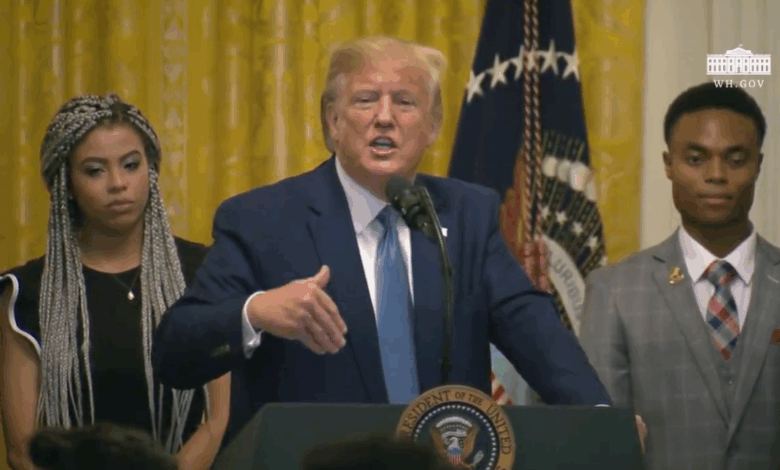
In 2019, during Donald Trump’s first term, he addressed a gathering of Black leaders at the Young Black Leadership Summit, declared to cheers, “You built the nation. We all built it, but you were such a massive part of it. Bigger than you were given credit for. Does that make sense?” He reinforced this on his campaign trail, launching “Black Voices for Trump” and pledging, “whether you voted for me or not, I would be your greatest champion.”
From praise to policy: A shift in tone on Black history
Fast forward to 2025, and the tone from the Trump administration has dramatically changed. President Trump’s White House has initiated a sweeping review of the Smithsonian museums, with direct critiques of the exhibits at the National Museum of African American History and Culture. Trump’s recent order, titled “Restoring Truth and Sanity to American History,” has drawn fierce criticism from historians and civil rights leaders, who argue it’s an attempt to sanitize or erase the legacy of slavery, segregation, and racism from the national narrative.
Historian Clarissa Myrick-Harris of Morehouse College summarized the concern: “It appears we are moving towards a narrative that attempts to deny the existence of slavery or the reality of Jim Crow laws, segregation, and racial violence against Black communities,” These actions are seen as a stark contradiction to the earlier campaign’s acknowledgment and praise of Black historical contributions.
Black History in classrooms and public institutions under threat
The scope of this revisionism is not limited to museums. There are increasing campaigns and executive actions targeting Black history curricula in the nation’s classrooms, part of a broader political backlash against discussions of race and systemic injustice in schools and public spaces.
The battle for justice in Black agriculture
One of the most urgent and persistent issues facing Black America is the ongoing discrimination against Black farmers, a struggle that stretches back generations. For years, Black farmers faced exclusion from federal loan and aid programs—a legacy acknowledged by the USDA but perpetuated under both Democratic and Republican leaderships.
Under the Trump administration, many Black farmers reported continued barriers to USDA support. Although landmark lawsuits like Pigford v. Glickman promised justice, the payout and agency reforms were slow and incomplete. It wasn’t until the Biden-Harris administration that Black farmers received a “historic” $1.5 billion allocation in a broader $2.2 billion package for all farmers discriminated against by the USDA. Many advocates argue this was an overdue but vital step, one that remains only a partial restoration of justice given the generation’s worth of land loss, debt, and unfulfilled promises.
Conclusion: A reckoning for the future
President Trump must halt attempts to undermine exhibits on Black Hisory. Instead of erasing history, his administration should support expanding the Smithsonian’s role in educating the nation about Black contributions as he has previously recognized. Specifically, the National Museum of African American History and Culture in Washington, DC, should build a dedicated exhibit celebrating Black farmers. A community whose contributions and struggles extend deeply into American history. From slavery-era forced labor and sharecropping systems to the ongoing fight against discrimination by agricultural institutions like the USDA, Black farmers’ legacy is central to understanding American agriculture and civil rights.
This moment calls for action beyond rhetoric. The promises made on the campaign trail to champion Black America must translate into policies and commitments that protect and celebrate Black history. President Trump’s administration has a responsibility to preserve these stories in their full truth and complexity and support efforts that acknowledge and restore justice for all Black communities, from classrooms to farms.
The future of Black America depends on honoring the past. President Trump must lead by preserving Black history as it is, supporting cultural institutions like the Smithsonian, and backing initiatives that spotlight important but often overlooked chapters, such as the enduring legacy of Black farmers.