


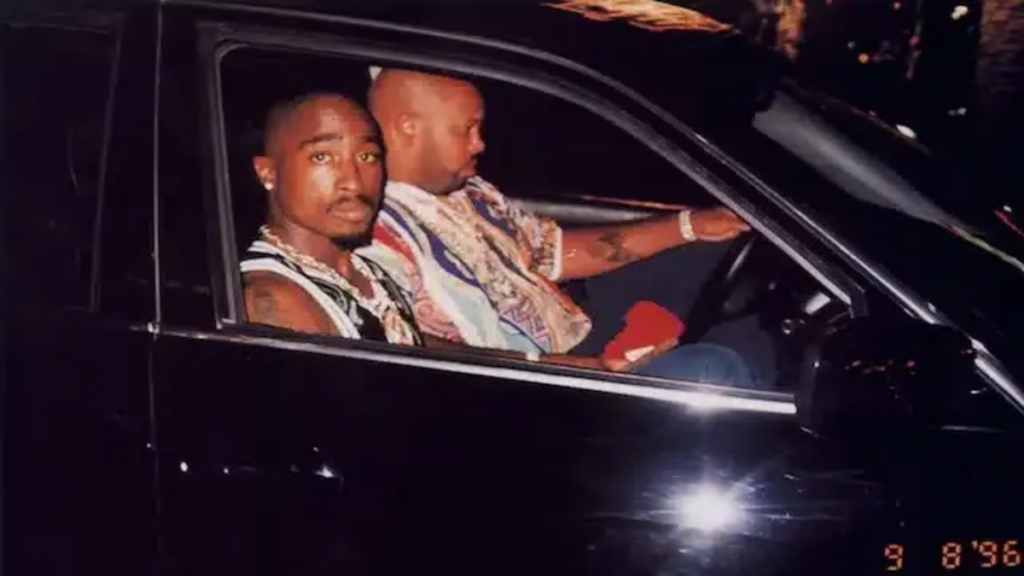
Part 1: The Icon, the MGM Grand Beatdown, and the Heat at Flamingo & Koval
Editorial & Legal Disclaimer: This article is Part 1 of a seven-part investigative and historical commentary series examining the public records, police filings, witness statements, and trial testimonies surrounding the September 7, 1996, shooting of Tupac Shakur. All individuals mentioned in connection with uncharged criminal activity or ongoing legal proceedings are presumed innocent unless proven guilty in a court of law. Allegations referenced are sourced directly from law enforcement affidavits, grand jury indictments, and recorded police proffer sessions.
Today marks 30 years since the shooting that led to one of the music industry’s greatest losses: Tupac Amaru Shakur. The James Dean of Hip Hop, Tupac was a recognizable force with raw talent that expanded beyond music into television and film as well.
Born Lesane Parish Crooks on June 16, 1971, in New York City to his mother Afeni Shakur, a former Black Panther who spent time in prison while pregnant with him for her alleged involvement in the Panther 21 case, his early life was shaped by political activism, art, and relentless movement across urban landscapes, from East Harlem to Baltimore, and ultimately to the Bay Area. He was renamed Tupac Amaru Shakur at age one, after the 18th-century Peruvian revolutionary who led an indigenous uprising against Spanish rule.
Afeni raised Tupac exposing him to music, literature, art, and history… Black History. He was well versed and appreciative of where he came from. As a great admirer of Rakim, Tupac developed his style and tried emulating Rakim’s. He was proud to be a product of New York and thrived to be a part of the legacy of the home of the Hip Hop community.
In Tupac’s track “Old School,” from his third studio album Me Against the World, he sends a poetic shoutout to the very community that raised him during his early childhood years, honoring the foundational New York City pioneers, from Grandmaster Flash and Rakim to Melle Mel and Slick Rick, who paved the way for his generation.

Yet that deep-seated reverence for his hometown would eventually curdle into bitter disillusionment. Following the traumatic 1994 ambush at Manhattan’s Quad Studios, his subsequent incarceration at Clinton Correctional Facility, and what he perceived as cold betrayal by former friends and peers within the New York hip-hop establishment, Tupac’s affection for the city hardened into deep-seated resentment. Aligning himself with Suge Knight’s West Coast titan, Death Row Records, he turned his razor-sharp pen against the very ecosystem he once revered.
It was with this intense emotional armor, fueled by paranoia and an uncompromising ride-or-die allegiance to Death Row, that Tupac arrived in Nevada on the hot desert night of September 7, 1996. Las Vegas was an arena of pure sensory overload—the high-roller suites, the neon glow of the Boulevard, and the heavy atmosphere setting the backdrop for one of the most anticipated sporting events of the year: Mike Tyson defending his WBA heavyweight title against Bruce Seldon at the MGM Grand Garden Arena.
In attendance was 25-year-old Tupac Shakur, riding the massive commercial high of his multi-platinum double album All Eyez on Me, alongside Marion “Suge” Knight. Tupac was at the peak of his cultural dominance, an artist whose raw intensity and charismatic swagger commanded every room he entered.
Inside the MGM, Tyson dispatched Seldon in just 109 seconds. But as the crowd trickled out into the casino’s tiled promenades, the atmosphere shifted from celebration to immediate danger.
The Incident in the MGM Promenade
As Tupac, Suge Knight, and their Death Row entourage traversed the casino lobby, Travon “Tray” Lane, a Death Row affiliate and Mob Piru Blood, spotted a familiar face standing near the elevator bank. It was 22-year-old Orlando “Baby Lane” Anderson, a known member of the South Side Compton Crips.
Months earlier, in May 1996, Anderson and a group of South Side Crips had allegedly jumped Tray Lane at a Foot Locker store inside the Lakewood Mall, stealing a gold Death Row Records medallion chain, a prized symbol of status within Knight’s inner circle.
Upon learning Anderson was in the lobby, Tupac marched across the concourse. Surveillance cameras mounted in the MGM Grand captured what happened next: Tupac confronted Anderson directly, asking, “You from the South?” before throwing a right hook that knocked Anderson to the floor. Members of the Death Row entourage immediately swarmed, delivering a flurry of kicks and punches before security personnel broke up the chaos.
Anderson was briefly detained by hotel security, but he declined to press charges and was released from the premises. Tupac and Knight exited the MGM Grand, returning to the Luxor Hotel to change clothes before heading toward Knight’s rented mansion and, ultimately, Club 662 on East Harmon Avenue for a scheduled charity benefit performance.
The Official Legal Record: The Retaliation at Flamingo & Koval
What unfolded next is not a matter of mere street speculation, but an established sequence of events documented across sworn grand jury testimony, police affidavits, and forensic evidence presented in court.
According to Clark County grand jury records and law enforcement filings, the altercation at the MGM Grand set into motion a swift, gang-related retaliation. Following the lobby beatdown, Orlando Anderson sought out his uncle, Duane “Keefe D” Davis, a high-ranking figure within the South Side Compton Crips. Enraged by the public beating, members of the crew orchestrated a response, acquiring a white 1996 Cadillac sedan and searching for Knight’s convoy across the Las Vegas Strip.
Around 11:15 PM, Suge Knight was driving his black 1996 BMW 750iL with Tupac sitting in the front passenger seat. As they idled at a red light at the intersection of Flamingo Road and Koval Lane, surrounded by a multi-car Death Row caravan, the white Cadillac pulled up alongside the BMW’s right flank.
An arm extended from the rear window of the Cadillac holding a .40-caliber Glock pistol. In a matter of seconds, fourteen rounds were fired into the passenger side of the BMW.
Tupac was struck four times: twice in the chest, once in the arm, and once in the thigh. One of the rounds perforated his right lung. Suge Knight suffered a shrapnel wound to the head but managed to U-turn the heavily damaged BMW onto the Strip before being pulled over and assisted by emergency responders near Las Vegas Boulevard.
The Physical Aftermath and the Unanswered Questions
Tupac was rushed to the University Medical Center of Southern Nevada, where trauma surgeons performed emergency surgery, removing his damaged right lung in an effort to halt severe internal bleeding. He was placed in a medically induced coma on life support.
While street rumors immediately identified Orlando Anderson as the shooter in the right rear seat of the Cadillac, Anderson repeatedly denied any involvement in the shooting during police interviews prior to his death in an unrelated gang shootout in May 1998.
For nearly three decades, the investigation into the shooting remained unsolved, giving rise to competing theories regarding the true orchestrators of the ambush, the origin of the firearm, and whether external corporate or rival rap factions had fueled the violent exchange.
It would take twenty-seven years, and the September 2023 arrest and murder indictment of Duane “Keefe D” Davis by Clark County authorities—for the events of September 7, 1996, to be formally presented before a criminal court.
Part 2 of “30 Years Later: The Don Killuminati and 7 Theories to His Death” continues tomorrow, examining the decades-long history between Keefe D, Bad Boy Entertainment, and how West Coast security contracts placed gang leadership inside rap’s biggest corporate rivalries.