Tesla Official Commercial Deployment: Cybercab Hits Austin Streets
The steering-wheel-free two-seater initiates passenger service while federal regulators audit Tesla’s self-certification pathway.
AUSTIN, Texas — Tesla officially deployed its first commercial fleet of purpose-built autonomous vehicles to public streets on September 3, 2026, introducing its steering-wheel-free Cybercab to ride-hailing passengers in Austin.
The launch marks a pivotal shift for the electric automaker, moving the Cybercab from a futuristic concept into a functional, revenue-generating service.
A Vehicle Built Without Human Controls
Unlike previous autonomous vehicles modified from standard production models, the Cybercab is built entirely around an unsupervised ride-hailing experience:
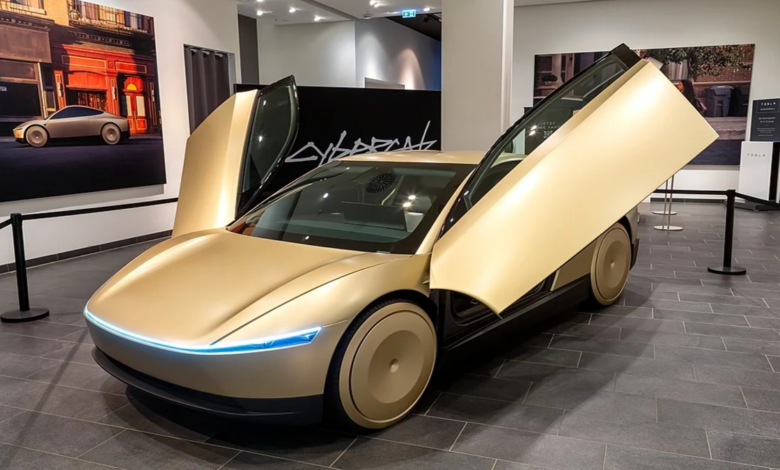
- No Manual Overrides: The gold-colored, two-seater vehicle features no steering wheel, brake pedals, accelerator, or traditional side-view mirrors.
- Passenger-Centric Cabin: Passengers enter through automated scissor doors into a lounge-like interior dominated by a large central display for entertainment, navigation, and trip tracking.
- Vision-Based Navigation: Relying strictly on Tesla’s camera-based Full Self-Driving (FSD) architecture rather than expensive LiDAR or radar arrays, the vehicle navigates urban intersections, lane merges, and pedestrian crossings through end-to-end neural networks.
Select riders in the Austin area can now select the Cybercab option alongside existing autonomous Model Y units through the Tesla Robotaxi mobile app. Initial passenger reports indicate that per-mile fares for the Cybercab are priced significantly lower than traditional ride-hailing services, aligning with Tesla’s target operating cost of under $0.30 per mile.
Seeking Partners for Global Deployment
As part of its commercial rollout, Tesla is actively soliciting deployment recommendations and partnerships through a dedicated portal at tesla.com/robotaxi/interest.
The automaker is inviting municipal leaders, commercial property owners, and transportation entities to submit regional interest across several critical expansion categories:
- Fleet Operations & Purchasing: Allowing third-party operators and commercial enterprises to express interest in purchasing and managing Cybercab fleets.
- Mobility Hubs & Infrastructure: Partnering with property managers and parking network operators to build out dedicated charging, staging, and cleaning infrastructure.
- Event Collaboration & Regional Feasibility: Gathering data on local regulatory landscapes, event staging, and demand patterns to prioritize the next wave of launch cities.
Regulatory Scrutiny and Self-Certification Audit
While the public rollout sent Tesla shares higher initially, it was immediately met with close government oversight.
The National Highway Traffic Safety Administration (NHTSA) opened an Audit Query (AQ) shortly after the deployment. Rather than auditing the lack of a physical steering wheel itself, the inquiry focuses on the certification path Tesla utilized under Federal Motor Vehicle Safety Standards (FMVSS).
Under U.S. regulations, automakers self-certify compliance before entering the market. Regulators are evaluating the technical data and process Tesla used to self-certify up to 1,000 Cybercabs without applying for a formal exemption, specifically examining whether Tesla’s compliance framework improperly relied on treating standard rules for human controls as inapplicable.
Tesla currently operates roughly 45 Cybercabs in Texas as part of a phased initial fleet. Company executives signaled that 24-hour daily service is scheduled to expand in the coming months as software updates rolled out across its autonomous network continue to log unsupervised testing miles.
*** Correction (September 7, 2026): An earlier version of this article overstated the scope of the NHTSA inquiry regarding the Cybercab’s physical design. The investigation is an Audit Query focused on Tesla’s self-certification process under Federal Motor Vehicle Safety Standards (FMVSS), rather than an audit of the absence of a steering wheel.