


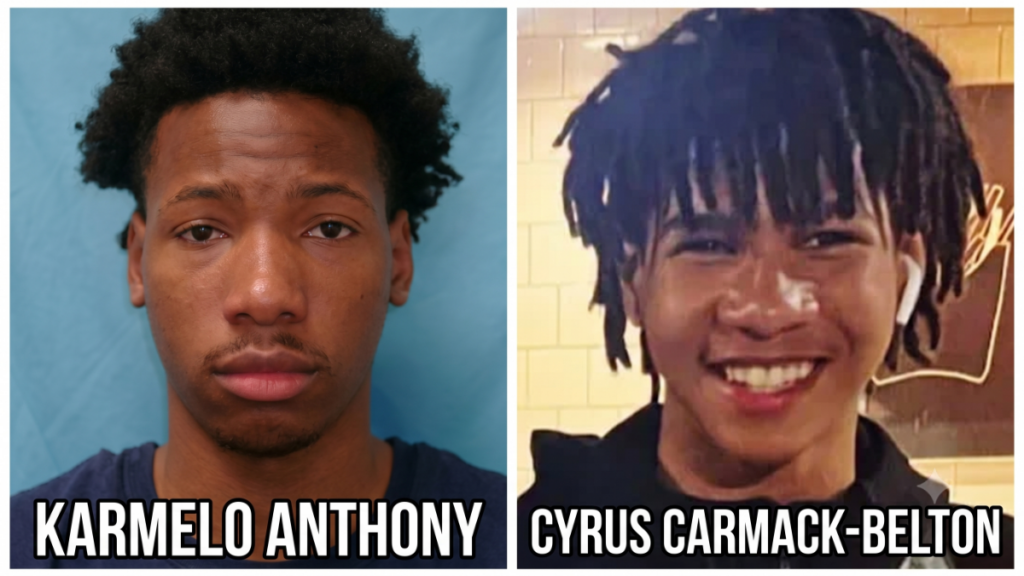
The chilling contrast between the cases of Cyrus Carmack-Belton and Karmelo Anthony exposes a legal system built on racial asymmetry.
The recent legal conclusions in the cases of Cyrus Carmack-Belton and Karmelo Anthony have reignited a raw, generational question. This inquiry echoes through Black communities, activist spaces, and kitchen tables across America. Is this country inherently out to harm Black America?
When viewed in isolation, the legal system frames these tragedies as unique, localized sequences of events. Each case is supposedly governed by specific state statutes. However, when you observe them together, they paint a devastating portrait of systemic asymmetry.
Consequently, these cases reveal a painful reality for Black youth. A Black teenager is rarely granted the grace of childhood innocence. Furthermore, they are rarely given the safety of de-escalation or the benefit of the doubt. This holds true whether the youth is a fleeing victim or a cornered accused.
The Two Faces of Threat Perception
The dichotomy of these two verdicts, delivered just days apart, provides a chilling look at how society weaponizes threat perception.
In South Carolina, a convenience store owner named Rick Chow falsely accused 14-year-old Cyrus Carmack-Belton of stealing water. Chow had a documented history of shooting at suspected shoplifters in 2015 and 2018. Despite this history, Chow chased the teenager down a public street. Ultimately, he shot Cyrus directly in the lower back while the boy was running away.
Yet, a local jury acquitted Chow of murder. The panel accepted the defense’s split-second claim of a threat. Because the judge legally suppressed Chow’s prior history of violence at trial, the jury evaluated the event in a complete vacuum. As a result, this verdict cements a painful precedent. The perceived threat of a fleeing Black boy is enough to justify his death in the eyes of the law.
Meanwhile, a different reality unfolded in Texas. A 17-year-old named Karmelo Anthony found himself in a high school track meet rain tent. Larger students confronted him and demanded he leave. When a physical shove escalated into chaos, Anthony made a catastrophic, split-second decision. He pulled a pocketknife from his backpack and fatally stabbed Austin Metcalf.
Body-camera footage captured Anthony sobbing to police immediately after his arrest. He cried, “He put his hands on me.” Despite this evidence of panic, a jury rejected his self-defense argument. Consequently, Anthony, now 19, was convicted of murder and sentenced to 35 years in prison.
The Systemic Asymmetry: A Comparative Look
To understand why the question “Is America out to harm Black America?” persists, we must analyze the mechanics of the justice system. For instance, notice how the framework functioned across both cases:
| Core Element | Cyrus Carmack-Belton Case (Columbia, SC) | Karmelo Anthony Case (Frisco, TX) |
| The Act | An adult chases and shoots a 14-year-old in the back over an unproven theft. | A 17-year-old stabs a peer during a physical confrontation under a tent. |
| Prior History | The shooter had two prior incidents of firing at customers; this was kept from the jury. | The teenager had no violent record but carried a prohibited pocketknife to school. |
| Jury Dynamics | A local jury deliberated for 8 hours before completely acquitting the adult shooter. | A jury with zero Black members deliberated for just 3 hours before convicting the teen. |
| The Outcome | The adult walks free; a Black child’s death is legally excused. | The young Black man is sentenced to 35 years; a white family is left permanently grieving. |
Observation: The Institutional Harm
The answer to whether America is out to harm Black youth does not require a coordinated, backroom conspiracy. For example, during the Anthony trial, internet rumors spread rapidly. People claimed that the victim’s father was close friends with the judge and prosecutor. However, investigators proved these photos and claims were entirely fabricated.
Therefore, the truth is much more sobering than a secret plot. The harm is institutional. It is baked directly into the ordinary legal framework of everyday American life.
First, this harm is visible in the jury selection process. In Texas, prosecutors used “race-neutral” explanations to remove prospective Black jurors. They struck Black women simply because they worked as educators. Consequently, they seated a panel with absolutely no Black representation.
Second, we see this bias in how courts apply self-defense laws. “Stand Your Ground” philosophies are applied with immense racial asymmetry. For instance, an adult’s fear of a Black child receives legal protection. Conversely, a Black child’s fear of a physical assault is dismissed as unprovoked malice.
The True Epidemic
When the dust settles on these verdicts, the systemic cycle remains unbroken. In one courtroom, an adult takes a Black teenager’s life with zero legal accountability. In another courtroom, the state consumes a Black teenager’s life with a three-decade prison sentence.
In both scenarios, the system functions exactly as designed. As a result, Black America is left to mourn the loss of its children, over and over again.