


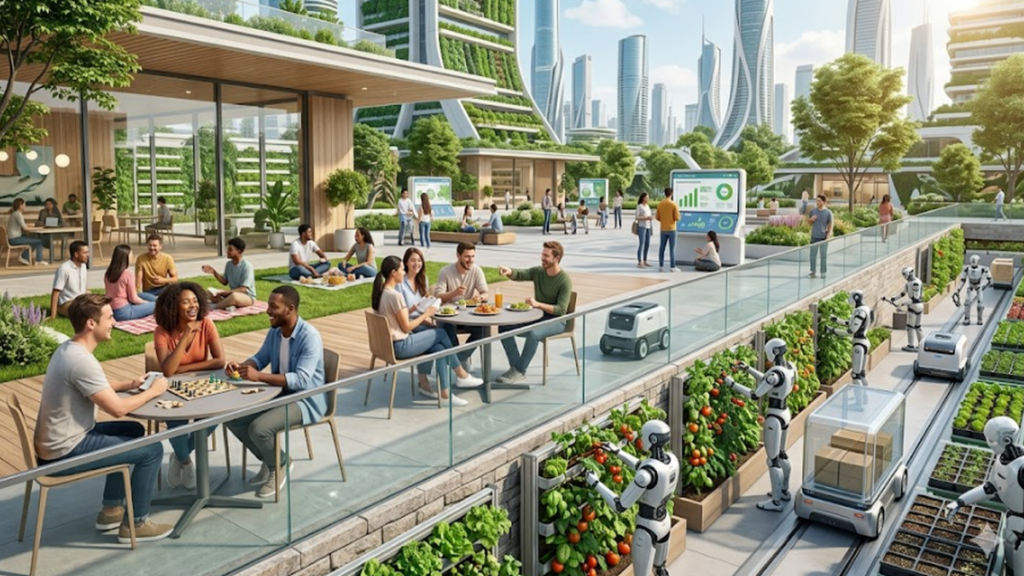
Exploring Elon Musk’s bold theory of AI-driven abundance and the economic storm it has ignited.
As artificial intelligence moves from the realm of “tech-bro fantasy” to a daily disruptor in the global workforce, the conversation around our economic survival has shifted from a whisper to a roar. Last week, Elon Musk double-downed on a concept that makes Universal Basic Income (UBI) look like pocket change: Universal High Income (UHI).
The theory is as bold as it is controversial. Musk argues that as AI and robotics (think Tesla’s Optimus) begin to handle the heavy lifting of the global economy, the output of goods and services will skyrocket. In his view, this massive surplus will crash the cost of living so low that “work” becomes a choice rather than a necessity.
The Math of Abundance
Musk’s core argument rests on the idea of post-scarcity. He claims that AI-driven productivity will grow at a rate far exceeding the money supply.
- The Deflation Defense: Usually, printing money leads to inflation. Musk argues that if robots produce 10x more food, clothing, and housing, prices will plummet, making government-issued checks more valuable, not less.
- The “Penthouse” Promise: When asked how everyone could afford luxury in this system, Musk recently asserted on X that AI would eventually make it so “everyone can have a penthouse if they want.”
The Reality Check: Critics Sound the Alarm
Not everyone is ready to trade their 9-to-5 for a robot-funded retirement. Economists and political leaders are raising major red flags about the feasibility of a sudden shift to UHI.
“Elon Musk’s universal high income will bankrupt any government that attempts it.”
— Sanjeev Sanyal, Economist and former advisor to India’s Ministry of Finance
- The Funding Gap: While Musk dreams of abundance, leaders like Rep. Ro Khanna (D-Calif.) are focusing on the “new social contract.” Khanna, an “AI Democratist,” argues that we need a 5% billionaire tax and a “Creator Bill of Rights” to protect human workers and creators right now, rather than waiting for a distant utopia.
- Finite Scarcity: Critics point out that even if robots make every iPhone for free, things like land, historic real estate, and human-led services are finite. If everyone has a high income, the price of a “penthouse” would simply skyrocket due to competition, potentially leading back to square one.
A Generational Shift or a Gilded Cage?
We are standing at a crossroads. On one hand, we have the promise of a Star Trek-like future where humanity is free to pursue art, exploration, and community. On the other, we face the risk of total economic collapse if we dismantle our labor systems before the “robot surplus” actually arrives.
What Do You Think?
As we watch the development of projects like Scorpio and the digital transformation of cities from Atlanta to the Bay Area, these “theoretical” debates are becoming very personal.
- Do you believe a government-funded “High Income” is actually possible without destroying the economy?
- If work became optional tomorrow, what would you do with your time?
- Are we moving toward a true “Age of Abundance,” or is this just a way for big tech to manage a jobless population?
Drop your thoughts below—let’s talk about the future we’re actually building.