


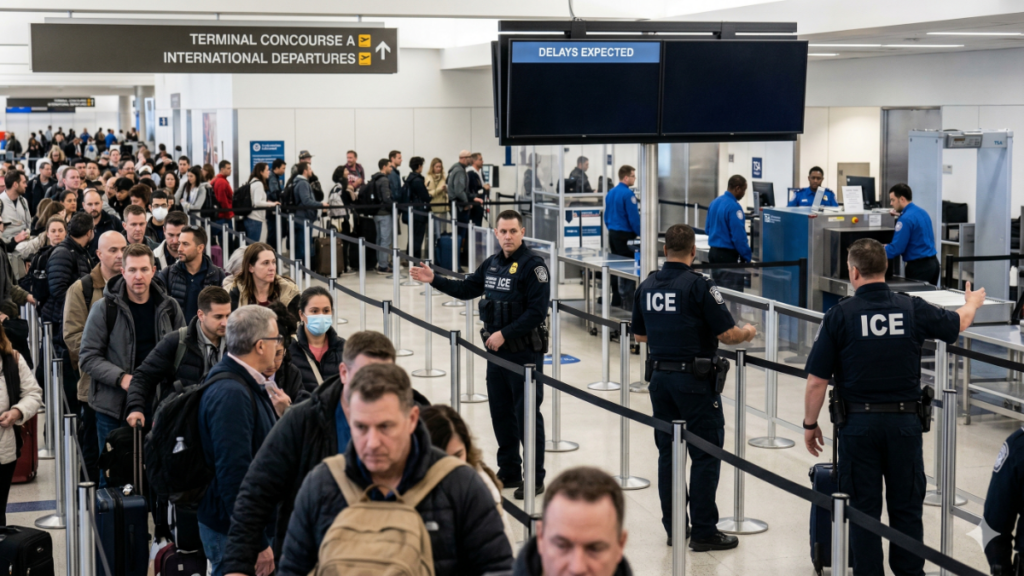
ICE Deployed to Major U.S. Airports Amid Surging TSA Shortages
WASHINGTON, D.C. — In a historic and controversial shift of federal resources, the Department of Homeland Security (DHS) began the nationwide deployment of Immigration and Customs Enforcement (ICE) personnel to the country’s busiest aviation hubs this morning, Monday, March 23, 2026.
The move comes as the partial government shutdown enters its sixth week, leaving the Transportation Security Administration (TSA) with a critical deficit of screeners and support staff.
A System Under Siege
The deployment is the administration’s “emergency ” solution to a travel infrastructure on the brink of collapse. With TSA officers working without pay for over 40 days, the agency has seen a 400% increase in resignations and record-high “call-out” rates.
Major international gateways—including JFK in New York, LAX in Los Angeles, and Hartsfield-Jackson in Atlanta—have reported security wait times exceeding five hours, leading to thousands of missed flights and grounded cargo.
“We cannot allow the nation’s commerce and mobility to grind to a halt,” a DHS spokesperson stated early Monday. “ICE personnel are being redirected to ensure that checkpoints remain open and that the traveling public remains safe during this fiscal impasse.”
Roles and Restrictions
Despite their presence at checkpoints, ICE agents are not stepping into full screening roles. According to operational guidelines released today, the agents will focus on:
- Perimeter & Exit Security: Monitoring “breach” points to free up certified TSA leads.
- Queue Management: Directing the massive crowds currently snaking through terminal lobbies.
- Document Verification: Assisting at the initial “Travel Document Checker” (TDC) stations.
However, federal regulations prohibit ICE agents from operating Advanced Imaging Technology (AIT) scanners or performing physical pat-downs, as they lack the specific FAA-mandated aviation security training.
National Backlash and Policy Shifts
The deployment has been met with immediate friction. Labor unions representing TSA workers have called the move a “band-aid on a bullet wound,” arguing that shifting law enforcement officers from the border and interior investigations to airports compromises national security on multiple fronts.
Further complicating the optics, a new directive requires all federal law enforcement on airport duty to remain unmasked, a policy shift that has sparked heated debate among health advocates and local port authorities.
What Travelers Need to Know
If you are flying this week, the “new normal” at U.S. airports includes:
- Extreme Lead Times: The FAA is recommending passengers arrive 4 to 5 hours before domestic departures.
- Visible Law Enforcement: Travelers should expect to see uniformed ICE and HSI (Homeland Security Investigations) agents in areas traditionally manned by blue-shirted TSA officers.
- Service Suspensions: Many TSA PreCheck lanes have been consolidated into general screening due to the lack of specialized staff.
As the funding deadlock in Congress shows no signs of thawing, the presence of ICE at the gate is no longer a temporary contingency—it is the frontline of American travel in 2026.