Supreme Court Strikes Down Trump’s Sweeping Tariffs
Supreme Court curbs presidential power on trade by invalidating Trump’s emergency tariffs.
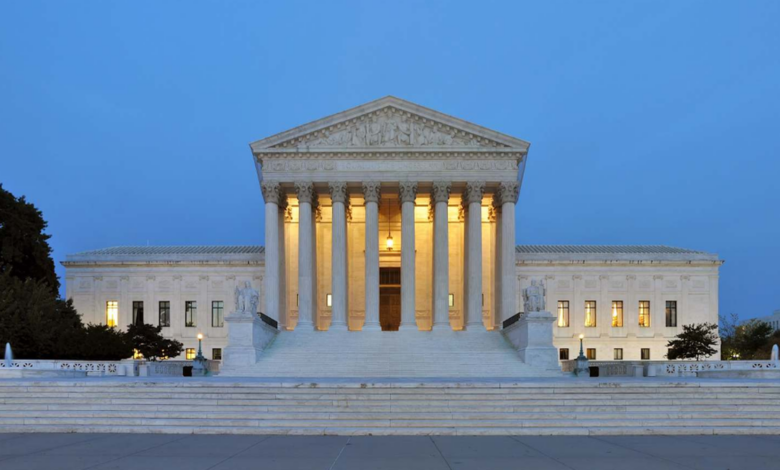
Supreme Court curbs presidential power on trade by invalidating Trump’s emergency tariffs.
The U.S. Supreme Court ruled 6-3 on February 20, 2026, that President Donald Trump exceeded his authority by imposing broad tariffs under the International Emergency Economic Powers Act (IEEPA) of 1977. Chief Justice John Roberts wrote the majority opinion in Learning Resources, Inc. v. Trump, stating that IEEPA’s language to “regulate… importation” does not authorize unbounded tariffs on imports from any country, product, rate, or duration.
Key Details of the Ruling
The decision invalidates major tariffs including the “Liberation Day” global 10% baseline duties announced in April 2025, reciprocal tariffs (up to 34% on China and varying rates elsewhere), and 25% fentanyl-related tariffs on goods from Canada, Mexico, and China. Steel and aluminum tariffs under separate Section 232 authority remain intact. Justices Neil Gorsuch and Amy Coney Barrett joined Roberts and the three liberals; dissenters Clarence Thomas, Samuel Alito, and Brett Kavanaugh argued IEEPA allows such measures as traditional tools for regulating imports.
Background and Challengers
The case consolidated suits from toy makers Learning Resources and hand2mind, plus V.O.S. Selections and others like pipe fittings manufacturers, who argued the tariffs violated Congress’s constitutional “power of the purse.” Lower courts, including the U.S. Court of International Trade and Federal Circuit, had already blocked the tariffs, prompting Supreme Court review. IEEPA tariffs generated about $130-133 billion by late 2025, roughly 60% of U.S. tariff revenue that year.
Economic and Political Impact
The ruling invokes the “major questions doctrine,” requiring explicit congressional approval for vast economic actions like these tariffs, which Trump tied to emergencies like drug trafficking and trade imbalances. It creates uncertainty on refunds for importers—likely handled by U.S. Customs and Border Protection via the Court of International Trade—potentially requiring billions in reimbursements. President Trump called the decision a “disgrace” and hinted at contingency plans, while the White House has not yet commented officially.
Reactions and Next Steps
Governors like California’s Gavin Newsom called for immediate refund checks, and businesses are preparing claims. Trump may pursue alternative statutes for some tariffs, but the decision limits unilateral executive power on trade. This marks a rare Supreme Court loss for the conservative-majority court during Trump’s second term.