Apple Taps Google’s Gemini To Rebuild Siri In Landmark AI Pact
Apple partners with Google to overhaul Siri using Gemini AI in a strategic shift toward speed over ownership
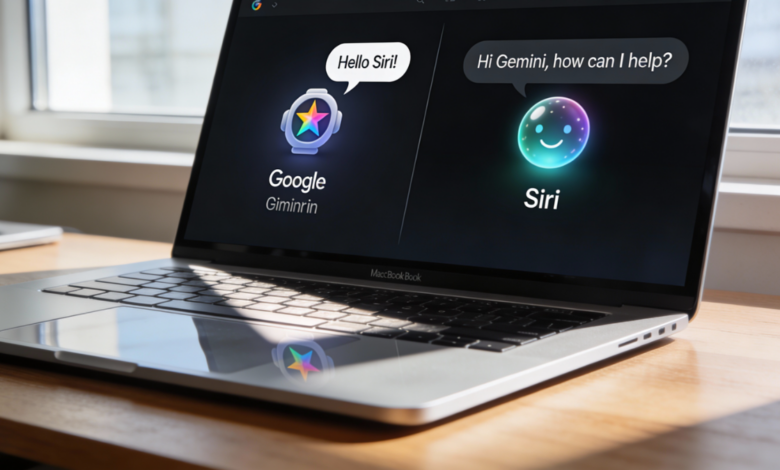
Apple partners with Google to overhaul Siri using Gemini AI in a strategic shift toward speed over ownership
In a landmark agreement announced this week, Apple and Google have forged an unexpected partnership. The iPhone maker will integrate Google’s Gemini AI models and cloud infrastructure into its products. This collaboration aims to deliver a significantly upgraded Siri and enhanced “Apple Intelligence” features later this year.
Details of the Partnership
Under the agreement, Apple’s new “Apple Foundation Models” will be built on Google’s Gemini platform. The models will run partly on Google Cloud infrastructure. However, Apple maintains control over how these models integrate with its devices and user experience.
The deal reverses the traditional flow of payments between the two companies. Bloomberg reports Apple may pay Google approximately $1 billion annually for custom Gemini models. This contrasts with Google’s longstanding payments to Apple for remaining the default search engine on Safari.
The upgraded Siri will leverage Gemini for complex reasoning and accessing broad world knowledge. Meanwhile, Apple’s on-device models and Private Cloud Compute system will handle sensitive user data. According to industry analysts, this architecture ensures Google “sees nothing” of users’ personal information.
Why This Deal Matters
The agreement represents a strategic pivot for Apple, a company that has long prided itself on owning every layer of its core technologies. For years, Apple maintained tight control over hardware, software, and services, believing this vertical integration gave it a competitive edge. But the AI revolution has forced a recalculation. Rather than spend years developing AI capabilities from scratch, Apple is now embracing a “partner for capability, own the experience” approach to accelerate Siri’s long-promised transformation.
For Google, securing Apple as a client represents both a technical and symbolic victory in the intensifying AI foundation-model competition. Gemini will gain prominent placement on hundreds of millions of Apple devices worldwide, providing Google with invaluable real-world deployment data. More importantly, this partnership validates Google’s AI capabilities against formidable rivals including OpenAI, Anthropic, and Meta. It signals to the market that Gemini can meet the exacting standards required by the world’s most valuable technology company.
The deal also highlights shifting power dynamics in big tech. Money once flowed primarily from Google to Apple for search distribution rights—Google reportedly pays Apple over $18 billion annually to remain the default search engine on Safari. Now, payments are beginning to move in the opposite direction for AI infrastructure. This reversal hints at emerging business models for the AI era, where companies with the best AI models become infrastructure providers to those with the largest distribution networks
What Users Can Expect From The New Siri
Apple has delayed its previously announced “reimagined Siri” that promised deeper personal context, on-screen awareness, and multi-step actions. Those ambitious features, originally slated for an earlier release, are now expected to arrive through this custom Gemini setup. The rollout will begin with an iOS update later this year, with industry insiders suggesting a spring timeframe is likely.
The new architecture divides responsibilities strategically. Gemini will handle complex reasoning tasks and tap into its vast knowledge base when users ask challenging questions or request information beyond simple facts. Meanwhile, Apple’s on-device models and Private Cloud Compute system will manage sensitive user data, ensuring privacy remains paramount. According to industry analysts familiar with the partnership, this design ensures Google “sees nothing” of users’ personal information—a critical requirement for privacy-conscious Apple.
With this division of labor, Apple aims to deliver an assistant that goes beyond answering questions in a chat window. The company envisions Siri reliably executing actions across third-party apps—booking restaurant reservations, placing online orders, updating calendar events, and submitting forms—all through natural conversation. Industry observers emphasize that Apple doesn’t need the largest or flashiest AI model to win this race. What Apple needs is an assistant people actually use regularly, week in and week out. This partnership represents a strategic bet to achieve that goal faster than going it alone.
The Bigger AI And Competition Picture
Apple’s choice of Google over other AI partners reflects broader strategic calculations beyond mere technical capabilities. OpenAI, initially a potential partner, has evolved into a full-fledged product company with consumer-facing applications like ChatGPT and enterprise solutions. This transformation makes OpenAI increasingly look like a direct competitor to Apple, particularly as OpenAI explores hardware partnerships and builds its own ecosystem. Choosing a company that competes directly with your core products makes little sense when alternatives exist.
Analysts describe the Apple-Google partnership as potentially one of the biggest in tech history—a rare collaboration between two giants who have competed fiercely for over a decade. Google anchors the infrastructure layer with its powerful AI models and cloud computing resources. Apple commands the consumer experience layer with hundreds of millions of loyal users and unmatched hardware-software integration. Industry insiders call it a “handshake at the edge of the stack,” where each company plays to its strengths without threatening the other’s core business.
For the broader AI industry—from OpenAI and Anthropic to smaller players—this deal raises the competitive stakes considerably. Winning marquee distribution deals may now require not only cutting-edge AI models but also the ability to operate at massive scale while meeting stringent privacy and security standards. The bar has been set at “good enough for Apple,” and that’s a formidable standard that will separate the AI winners from the also-rans in the coming years.